DEXA scan: what bone density testing reveals — and who needs it
27 February 2026
Almost 9 in 10 Europeans say they want to take a more proactive approach to their health. Yet bone density — one of the most quietly consequential markers of long-term health — rarely gets checked until something breaks.
That's a gap worth closing. A DEXA scan takes 15 minutes, uses a fraction of the radiation of a chest X-ray, and gives you a precise, quantified picture of your skeletal health and body composition. For most people, it's the first time they've ever seen that data. Here's what it measures, what the results mean, and how to know whether you should get one.
What a DEXA scan actually measures
DEXA stands for dual-energy X-ray absorptiometry. The scanner passes two low-energy X-ray beams through your body and measures how much is absorbed by bone versus soft tissue. The difference tells it — with remarkable precision — how dense your bones are and what your body is made of.
The scan produces two categories of data.
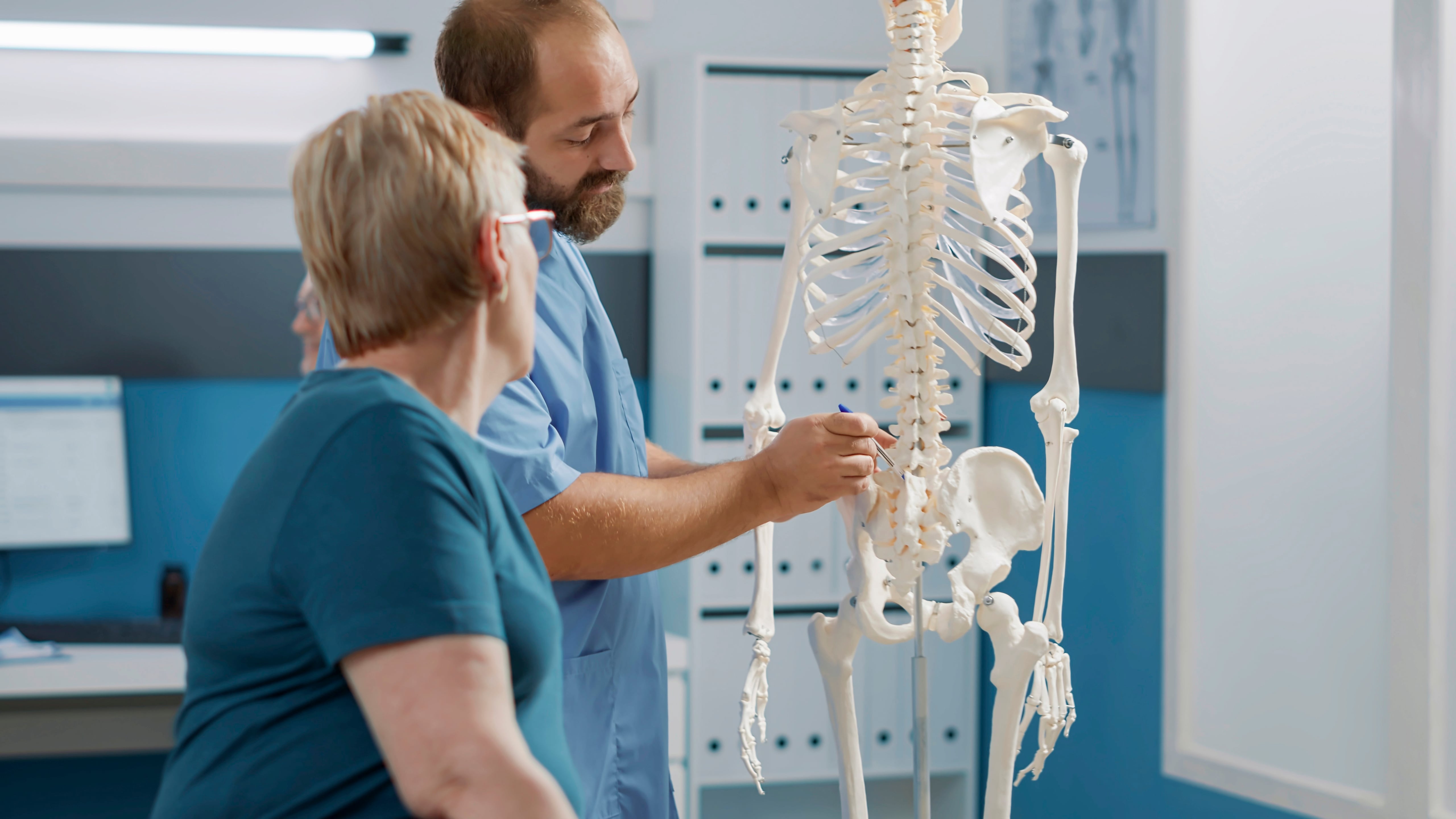
Bone mineral density (BMD) is the primary output. The scanner focuses on sites most vulnerable to fracture: typically the lumbar spine (L1–L4) and the femoral neck (where the thigh meets the hip). These are the locations most likely to fracture if bone loss has occurred, and they're where the data matters most clinically.
Body composition is the second layer. A full-body DEXA gives you lean mass, fat mass, and — critically — visceral fat, the metabolically active fat stored around your internal organs. Unlike the fat you can pinch, visceral fat isn't visible and doesn't correlate reliably with BMI or how someone looks. High visceral fat is an independent risk factor for cardiovascular disease, type 2 diabetes, and metabolic syndrome. DEXA is one of the most accurate non-invasive ways to measure it.
T-scores and Z-scores: reading your results
Your bone density result is expressed as a T-score. This compares your bone density to a reference group of healthy young adults at peak bone mass. The World Health Organization defines the categories as follows:
| T-score | Classification | What it means |
|---|---|---|
| Above −1.0 | Normal | Bone density is within the healthy range |
| −1.0 to −2.5 | Osteopenia | Below-average density; not yet osteoporosis |
| Below −2.5 | Osteoporosis | Significantly reduced density; fracture risk is elevated |
Osteopenia is not a disease. It's a signal — your bones are losing density faster than expected, and without intervention, osteoporosis becomes more likely. Think of it as a yellow light, not a red one. The value of catching it early is that diet, exercise, and occasionally medication can meaningfully slow or reverse the trajectory.
Osteoporosis is more serious. The International Osteoporosis Foundation estimates that one in three women and one in five men over 50 will experience an osteoporosis-related fracture in their lifetime. In Switzerland, approximately 300,000 people are affected, with hip fractures alone costing the healthcare system several hundred million francs annually.
Your report may also include a Z-score, which compares your density to people of the same age and sex. A Z-score tells you how you rank against your peers; a T-score tells you how you rank against optimal bone mass. Clinicians typically use the T-score for diagnosis, but the Z-score is useful context — particularly for younger adults where the T-score comparison to peak bone mass may be less meaningful.
Who should get a DEXA scan?
The conventional answer is women over 65 and men over 70. Swiss guidelines from the Schweizerische Vereinigung gegen Osteoporose (SVGO) recommend screening within those thresholds, with earlier testing when risk factors are present.
But bone loss often begins well before symptoms appear — and well before standard screening kicks in. The following groups have meaningful reason to get a baseline scan earlier.
Women approaching or past menopause. Estrogen protects bone density. When it drops, bone loss accelerates — sometimes rapidly. The decade following menopause is when most women lose the majority of bone they'll ever lose. Getting a baseline scan around 45–50 means you can monitor the rate of change, not just discover damage after the fact.
Endurance athletes and people with low body weight. This one surprises people. Athletes — particularly runners, cyclists, and those in weight-class or aesthetic sports — can have surprisingly poor bone density despite their fitness. Low energy availability (not eating enough relative to training load) disrupts hormonal cycles in women and testosterone levels in men, both of which are critical for bone maintenance. The condition is part of what clinicians now call Relative Energy Deficiency in Sport (RED-S). DEXA is the standard tool for assessing it.
People on long-term corticosteroids. Medications like prednisolone, used for autoimmune conditions, asthma, and inflammatory bowel disease, are among the most significant secondary causes of bone loss. Many people on these medications for six months or more haven't had their bone density checked. They should.
Anyone with a family history of osteoporosis or a previous fragility fracture. Genetics matter, and a fracture from a minor fall in your 40s or 50s is a signal worth investigating.
Men over 50 with risk factors. Male osteoporosis is underdiagnosed. Low testosterone, heavy alcohol use, smoking, and long-term corticosteroid use all raise risk, and men are less likely than women to be screened proactively.
DEXA vs. other ways to assess bone health
A standard blood panel can pick up markers associated with bone metabolism — vitamin D, calcium, parathyroid hormone (PTH), and bone turnover markers like osteocalcin or CTX. These are useful for understanding why bone loss may be occurring, but they don't measure the structural reality of your bones. Blood markers and DEXA answer different questions and work best together.
Full-body MRI, Ahead's primary screening tool, is exceptional at detecting soft-tissue pathology, organ abnormalities, and certain musculoskeletal findings. It does not, however, measure bone mineral density with the precision that DEXA does. The two scans are complementary, not interchangeable.
| Modality | What it measures well | Limitation |
|---|---|---|
| DEXA scan | Bone mineral density, body composition, visceral fat | Limited soft-tissue detail |
| Full-body MRI | Organs, soft tissue, musculoskeletal structure | Does not quantify bone density |
| Blood panel | Bone metabolism markers, hormonal drivers | No structural measurement |
This is where the "hardware and software" analogy holds up. Your MRI shows the structure of your body — the hardware. Blood markers reveal the biochemical processes underneath — the software. DEXA adds a third layer: a precise measurement of one of the most critical structural assets you have.
As Ahead's founding medical advisor Dr. Anna Erat puts it: "Nowadays in preventive medicine, we want to triangulate methods." A DEXA result sitting alongside your MRI findings and blood panel gives your physician — or Ahead's reviewing doctors — a much richer picture than any single test alone.
What happens if something is found?
The short answer: you gain time to act.
If your T-score indicates osteopenia, lifestyle changes are effective. Resistance training — particularly weight-bearing exercise — directly stimulates bone formation. Adequate calcium (around 1,000–1,200 mg/day for adults over 50) and sufficient vitamin D (which many Swiss adults are low in, particularly through winter) are foundational. Your GP may recommend monitoring with a follow-up scan in two to three years.
If your T-score falls into the osteoporosis range, your physician may recommend pharmacological treatment alongside lifestyle changes. Bisphosphonates are the most commonly used class of medication and have a strong evidence base for reducing fracture risk.
Finding a T-score of −2.0 at 52 is not bad news — it's the best time to find it. Catching bone loss before a fracture occurs is precisely the point of screening.
DEXA at Ahead
Ahead offers DEXA as a CHF 135 add-on to any full-body check-up package. The scan covers bone mineral density at the spine and hip, plus a full body composition analysis including regional fat distribution and visceral fat.
Results are reviewed by Swiss board-certified physicians and incorporated into your overall health report — so your DEXA findings sit alongside your MRI results and blood panel rather than arriving as a standalone number without context.
If you're combining DEXA with the Ahead Advanced or Pro package , your blood panel will already include vitamin D, which is often the first thing a physician looks at when interpreting a low bone density result.
Supplementary health insurers may cover part of the cost for our full-body check-ups. For example, KPT's supplementary insurance "Pulse" reimburses up to CHF 1,500 for Ahead Health services.
Book the DEXA add-on at aheadhealth.com/dexa-scan .