Iron deficiency: what a full iron panel can tell you
5 May 2026



You're sleeping enough. You're not particularly stressed. But you feel exhausted anyway, the kind of tired that doesn't lift after a good night's sleep. Maybe your hair has been falling out more than usual, or you find yourself short of breath climbing stairs you used to take without thinking.
An estimated 40-55% of European women of reproductive age have small or depleted iron stores , and around 1 in 3 globally have anaemia , yet iron deficiency is also one of the most frequently missed diagnoses in routine care. Not because it's difficult to diagnose, but because the blood markers that reveal early depletion aren't part of most routine panels.
This article explains what iron deficiency actually means, how it shows up in your body before it leads to anaemia , which blood markers are the most useful, and what the evidence says about different types of iron supplements.
Why iron matters more than most people realize
Iron is not just a component of red blood cells. It is essential for energy production at the cellular level, for thyroid function, for immune response, for cognitive performance, and for carrying oxygen . When your iron stores fall, the effects ripple across multiple systems, which is why the symptoms are so varied and easy to attribute to other causes.
Iron deficiency exists on a spectrum . It starts as iron depletion : your stores are falling, but your red blood cells look normal and function relatively normally. At this stage, you might feel nothing at all or have very mild fatigue , reduced concentration , and hair shedding.
This can then lead to iron-deficient erythropoiesis : iron stores are completely empty, and the iron supply to the bone marrow is no longer sufficient. Red blood cell production is beginning to be impaired, though the cells may still appear normal in size and number on a standard blood count. Haemoglobin may fall within the low end of the normal range. Symptoms become more noticeable at this stage — fatigue, reduced concentration, pale skin, dizziness — even before formal anaemia is diagnosed.
The last stage is hypochromic microcytic anaemia: severe, prolonged iron deficiency leading to the production of small (microcytic) and pale (hypochromic) red blood cells. At this stage symptoms may become more severe, including shortness of breath and heart palpitations. This stage is what most standard check-ups are designed to detect.
The first two stages often go unaddressed for months or years, because symptoms can be mild and basic blood panels can appear low but within ‘normal’ range. A standard haemoglobin result may come back within range while stores are already substantially depleted, which is why a more complete panel changes the picture.
How iron deficiency shows up
Symptoms of iron deficiency are easy to overlook because they tend to be gradual and non-specific. The most common include:
- Persistent fatigue that doesn't improve with rest
- Difficulty concentrating or brain fog
- Hair thinning or increased shedding
- Brittle nails, or nails that develop a concave shape
- Cold hands and feet
- Shortness of breath with moderate exertion
- Restless legs, especially at night
- Pale skin, inner eyelids, or gums
- Frequent headaches
- Unusual cravings for ice or clay foods, a phenomenon called pica
Because symptoms are gradual, they are often normalized over time. Fatigue becomes background noise, exercise tolerance drops, and the connection to iron is often only made once levels are actually measured.
Testing for iron deficiency: what the different indicators tell you
A standard complete blood count (CBC) includes several measurements, but the ones most relevant to iron deficiency are haemoglobin (the concentration of the oxygen-carrying protein in red blood cells), hematocrit (the percentage of blood volume made up of red blood cells), and MCV (mean corpuscular volume which is the average size of a red blood cell). These markers only change once iron deficiency is well established. They will not catch the earlier stages.
To understand where you actually stand, you need a more complete picture.
Serum ferritin is the most important single marker. Ferritin reflects your iron stores, the depot your body draws on when intake is insufficient. Low ferritin is the first sign of depletion , before haemoglobin changes at all. The challenge is that reference ranges in standard labs are set very wide . A ferritin of 12 µg/L is technically "normal" by many lab standards, but many clinicians now use a functional threshold of 30–50 µg/L or symptomatic patients, particularly women. Below that level, symptoms are common even when haemoglobin is normal.
Serum ferritin is also an acute-phase protein , which means it rises during inflammation or infection. This is important: if you have an ongoing inflammatory condition, your ferritin may look normal or even elevated while your iron is actually depleted. Measuring inflammatory markers in parallel, such as hsCRP, ESR, and composite indices like SIRI and SII, helps clarify whether a ferritin value is being artificially lifted by inflammation.
Serum iron shows how much iron is currently circulating in the bloodstream. On its own it tells you relatively little, because it fluctuates throughout the day (highest in the morning and dropping significantly by the afternoon) and is influenced by recent meals and inflammation. Read together with the next two markers, it becomes informative.
Transferrin is the protein your body uses to transport iron in the blood. When iron stores are low, the body produces more transferrin in an attempt to capture more of the iron that's available. Elevated transferrin alongside low ferritin is a classic early signal of depletion, often visible before haemoglobin moves.
Transferrin saturation is the percentage of transferrin that is actually carrying iron. Low transferrin saturation alongside low ferritin strengthens a deficiency picture, and in the presence of inflammation it can be a more reliable marker than ferritin alone , because it is less influenced by the acute-phase response.
A thorough iron panel covers at minimum ferritin, serum iron, transferrin, and transferrin saturation, interpreted alongside inflammatory markers when relevant.
Choosing a supplement: food, supplements, and different forms of iron
Getting iron from food first
Before turning to supplements, it's worth understanding what diet can and can't achieve.
Iron from food comes in two forms:
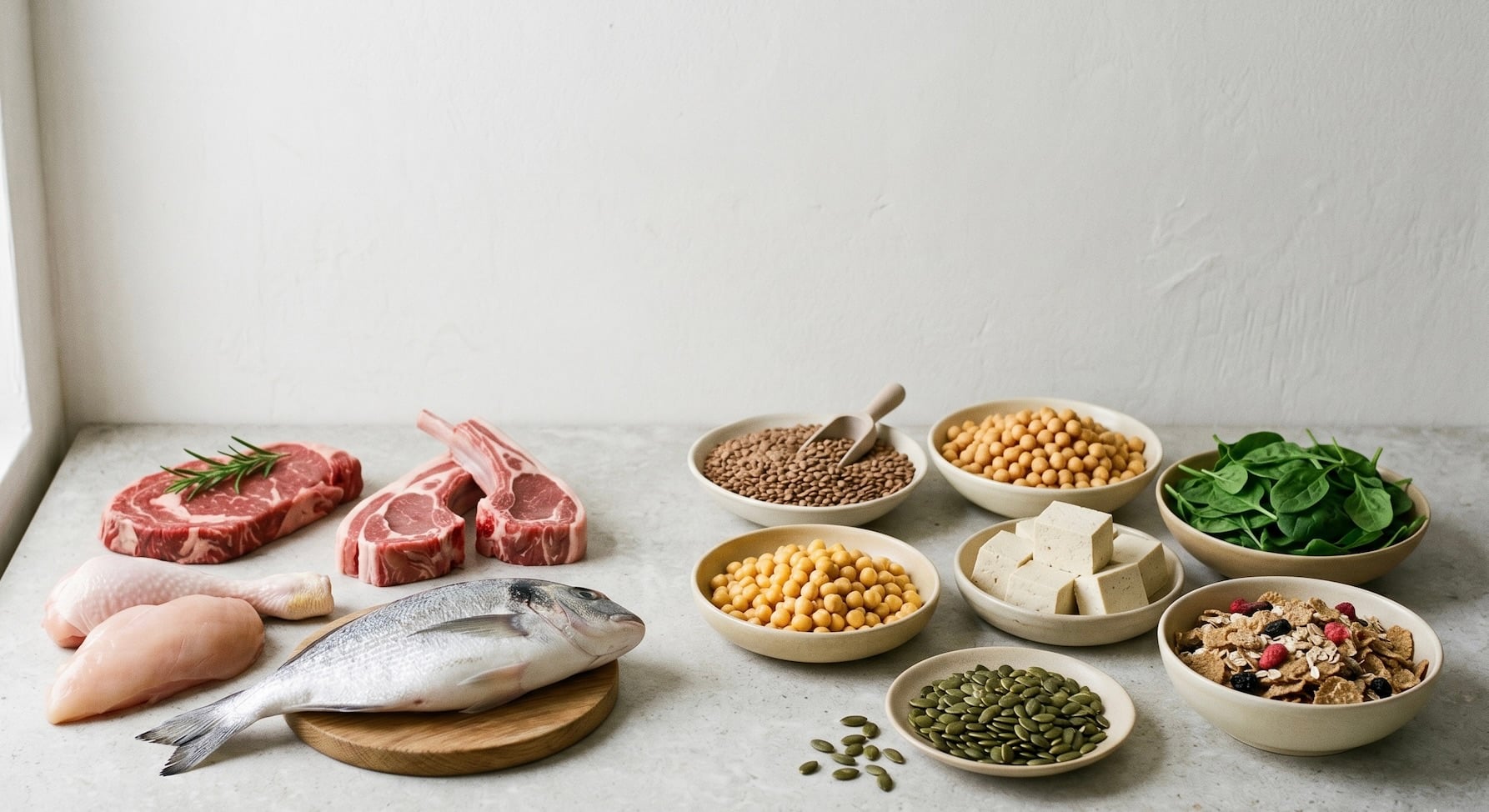
- Haem iron, found in red meat, poultry, and fish, is absorbed efficiently: approximately 25% of the iron in a portion of beef or lamb is taken up by the gut.
- Non-haem iron, found in plant foods such as lentils, chickpeas, spinach, tofu, pumpkin seeds, and fortified cereals, is absorbed at a much lower rate, typically 17% or less, depending on what else you eat at the same meal.
For most healthy adults with mild depletion, a diet consistently rich in haem iron sources can help maintain stores. Vegetarians and vegans who eat a varied diet with plenty of legumes, seeds, and vitamin C alongside iron-rich plants can also maintain adequate levels, though it takes more attention to food pairing and the margin for error is smaller.
Where diet alone tends to fall short is in the context of significant deficiency, heavy menstrual losses, pregnancy, or malabsorption. In those situations, food can slow the decline but typically cannot reverse it quickly enough. The gut can only absorb so much iron per day regardless of intake, and raising depleted stores meaningfully usually requires supplemental iron, at least in the short to medium term.
Supplement forms: what the evidence says and what to choose
If you've been told to take iron, or are considering supplementing, the form matters. Here is how to think about the main options and where to start.
Ferrous sulfate is the most commonly prescribed form and is inexpensive. It has strong absorption in iron-deficient individuals, but it is also the form most associated with gastrointestinal side effects: constipation, nausea, and stomach cramps. These side effects lead many people to stop taking it.
Ferrous gluconate and ferrous fumarate are also ferrous (iron 2+) forms. They tend to be gentler on the gut than ferrous sulfate while maintaining reasonably good bioavailability. Ferrous gluconate in particular has a reasonable evidence base for tolerability.
Ferric forms (iron 3+), such as ferric phosphate or ferric pyrophosphate, need to be converted to the ferrous form in the gut before absorption, which makes them less bioavailable in most circumstances. Some newer formulations use micronized or liposomal delivery to improve this.
Liposomal iron encapsulates iron in a lipid layer that allows it to be absorbed through a different pathway, bypassing some of the gut reactions that cause side effects with traditional supplements. Some randomized trials suggest liposomal iron may perform comparably to ferrous sulfate for raising ferritin, with consistently fewer gastrointestinal complaints, though the evidence base is still developing.
Iron bisglycinate (iron chelate) is a form bound to the amino acid glycine. It has better absorption than ferric forms and is generally well-tolerated, with a systematic review and meta-analysis finding fewer GI adverse events compared with other iron supplements , making it a popular choice in food supplements sold without prescription.
For most people starting supplementation, ferrous gluconate, ferrous fumarate, or iron bisglycinate are reasonable first choices: better tolerated than ferrous sulfate, with good bioavailability, and widely available in pharmacies without prescription. If you've tried ferrous sulfate before and stopped because of stomach problems, any of these three is worth trying instead. If you've tried oral iron repeatedly without raising your ferritin, or can't tolerate it at all, that's the point at which intravenous iron becomes worth discussing with your doctor.
Practical points on dosing and routes of administration
Iron absorption is enhanced by vitamin C taken at the same time, and inhibited by calcium, tannins (tea, coffee), and phytates (wholegrains, legumes). Taking iron on an empty stomach increases absorption but also increases the chance of stomach upset. Alternate-day dosing, taking iron every other day rather than daily, has evidence supporting better net absorption, because daily dosing triggers a hepcidin response that temporarily reduces absorption the following day.
Beyond oral supplements, two other routes of administration are used clinically when oral iron isn't working or isn't tolerated.
Intravenous (IV) iron infusion delivers iron directly into the bloodstream, bypassing the gut entirely. It is typically reserved for people with significant anaemia, malabsorption conditions such as inflammatory bowel disease or coeliac disease, or those who have repeatedly failed oral supplementation. IV iron can raise ferritin levels substantially faster than oral routes, often within weeks, and newer formulations such as ferric carboxymaltose can deliver a full therapeutic dose in a single session . It requires a clinical setting and carries a small risk of infusion reactions, though serious adverse events are uncommon with modern preparations.
Intramuscular (IM) iron injection is an older method that is now rarely used. Absorption is unpredictable and the injections can be painful and cause lasting skin discoloration at the injection site. IV iron has largely replaced it in clinical practice.
For most people with confirmed deficiency who don't have a malabsorption condition, oral iron taken correctly and in a well-tolerated form remains the standard starting point. IV infusion is an effective escalation option when oral therapy isn't sufficient.
None of this replaces a proper assessment. Supplementing without knowing your actual levels means you may take more than you need. While iron toxicity from food sources isn't a concern, excessive supplementation over time carries real risks. Testing first gives you a baseline, tells you whether deficiency is present, and lets you track whether the intervention is working.
How Ahead measures your iron status
Ahead's Advanced Blood Test includes a comprehensive iron panel, covering ferritin, serum iron, transferrin, and transferrin saturation, interpreted alongside inflammatory markers (hsCRP, ESR, SIRI, SII) so that ferritin can be read in context. This is part of a broader analysis of more than 80 biomarkers. Results are reviewed by Swiss board-certified physicians, not just flagged against standard reference ranges. That distinction matters for iron in particular, where the clinical interpretation often diverges from what a lab's automated threshold would flag.
Ahead's services complement your GP rather than replacing them. If deficiency is confirmed, the report gives you and your doctor a clear, documented baseline to work from.
Conclusion
Iron deficiency is common, under-detected, and often under-treated, not because it's hard to measure, but because the standard tests don't always measure enough. Haemoglobin alone tells you whether you're anaemic. Ferritin, serum iron, transferrin, and transferrin saturation together tell you where you are on the path before you get there.
If you've been tired in a way that doesn't make sense, or your hair is falling out and your GP hasn't found anything, it's worth asking whether your iron stores have actually been checked, not just your red blood cells.
Sources
- Milman N et al. Iron status in pregnant women and women of reproductive age in Europe. American Journal of Clinical Nutrition . 2017;106(Suppl 6):1655S–1662S. https://pubmed.ncbi.nlm.nih.gov/29070543/
- World Health Organization. Anaemia in women and children. https://www.who.int/data/gho/data/themes/topics/anaemia_in_women_and_children/ /
- Dignass A, Farrag K, Stein J. Limitations of Serum Ferritin in Diagnosing Iron Deficiency in Inflammatory Conditions. 2018. PMC5878890.
- Camaschella C. Iron-deficiency anemia. New England Journal of Medicine . 2015;372(19):1832–1843. https://pubmed.ncbi.nlm.nih.gov/25946282/
- Vaucher P et al. Effect of iron supplementation on fatigue in nonanemic menstruating women with low ferritin: a randomized controlled trial. CMAJ . 2012;184(11):1247–1254. https://doi.org/10.1503/cmaj.11095
- Greig AJ et al. Iron deficiency, cognition, mental health and fatigue in women of childbearing age: a systematic review. J Nutr Sci 2013;2:e14. https://pmc.ncbi.nlm.nih.gov/articles/PMC4153327/
- Jäger L et al. Ferritin Cutoffs and Diagnosis of Iron Deficiency in Primary Care. JAMA Network Open, published August 5, 2024; 7(8):e2425692. https://pmc.ncbi.nlm.nih.gov/articles/PMC11301556/
- Ogun AS, Adeyinka A. Biochemistry, Transferrin. StatPearls. https://www.ncbi.nlm.nih.gov/books/NBK532928/
- Moustarah F, Daley SF. Dietary Iron. StatPearls. https://www.ncbi.nlm.nih.gov/books/NBK540969/
- Fischer JAJ et al. The effects of oral ferrous bisglycinate supplementation on hemoglobin and ferritin concentrations in adults and children: a systematic review and meta-analysis of randomized controlled trials. Nutrition Reviews , 2023;81(8):904–920. https://pmc.ncbi.nlm.nih.gov/articles/PMC10331582/
- Rangaraj S et al. Liposomal iron vs. conventional iron in the treatment of iron deficiency anemia in children: a randomized controlled trial. Cureus , 2025. https://pmc.ncbi.nlm.nih.gov/articles/PMC12718472 /
- Stoffel NU, et al. Iron absorption from oral iron supplements given on consecutive versus alternate days and as single morning doses versus twice-daily split dosing in iron-depleted women: two open-label, randomised controlled trials. Lancet Haematology . 2017;4(11):e524–e533. https://doi.org/10.1016/S2352-3026(17)30182-5
- Moretti D, et al. Oral iron supplements increase hepcidin and decrease iron absorption from daily or twice-daily doses in iron-depleted young women. Blood . 2015;126(17):1981–1989. https://pubmed.ncbi.nlm.nih.gov/26289639/
- Friedrisch JR, Cançado RD. Intravenous ferric carboxymaltose for the treatment of iron deficiency anemia. Revista Brasileira de Hematologia e Hemoterapia. 2015;37(6):400-405. https://pmc.ncbi.nlm.nih.gov/articles/PMC4678908/
Frequently asked questions

Growth Lead
Led commercial and strategy projects in Life Sciences and Global Public Health at McKinsey & Company, including work across commercial due diligence, market access, and growth strategies. Holds a Master's in Banking and Finance from the University of St. Gallen with a focus on data science and quantitative methods.