You eat reasonably well. You sleep most nights. Yet every cold in the office seems to find you, and a cut on your hand takes weeks to fade. Your standard blood test comes back normal, so the conversation ends there.
Here's the thing: many standard panels never look at the minerals your body needs in the smallest amounts. A trace elements blood test measures three of them, zinc, selenium and copper, plus the balance between zinc and copper. Together they shape how well your immune system responds, how your thyroid converts hormones, and how your cells protect themselves from everyday wear.
This guide explains what each trace element does, why Switzerland has a particular story with selenium, who tends to run low, and what measuring these markers can and can't tell you.
What trace elements are, and why tiny amounts matter
Trace elements are minerals your body needs in microgram or low milligram quantities. Compare that to calcium or magnesium, which you need in hundreds of milligrams a day. The amounts are small, the jobs are not.
Many trace elements work as cofactors: the helper molecules that bind to enzymes to activate or catalyze vital biochemical reactions. Without enough of them, these enzymes can't do their job properly. When a shortfall does cause signs, they tend to be vague and have many other possible causes.
| Trace element | Main roles in the body | Main food sources |
|---|---|---|
| Zinc | Immune defense, wound healing, cell growth, metabolism, reproduction | Meat, cheese, milk, eggs, nuts, whole grains |
| Selenium | Thyroid hormone conversion, antioxidant defense, immune function, fertility | Fish, eggs, meat, Brazil nuts |
| Copper | Iron transport, connective tissue, nervous system, energy metabolism, immune function | Offal, fish, nuts, seeds, whole grains, legumes, cocoa |
Your body cannot make any of them. Everything you have comes from what you eat and drink, including supplements. How much you absorb depends on your gut, your diet and some medications, and how much you need changes with age, pregnancy and breastfeeding.
Zinc: a key mineral for your immune system
Zinc is part of many enzymes and proteins, according to the German Nutrition Society (DGE) . It is involved in cell growth, wound healing, metabolism, the immune system and reproduction.
What low zinc can feel like
Zinc deficiency rarely announces itself clearly. Signs that can point to it include:
- Frequent or lingering infections
- Slow wound healing
- Skin changes, such as eczema
- Diarrhea
- Problems with perception or memory
- A weaker sense of taste or smell, which can appear even with a mild deficiency ( gesund.bund.de, 2021 )
- Hair loss, usually only with a more severe deficiency ( gesund.bund.de, 2021 )
None of these is specific to zinc. That's the tricky part: each one has many possible explanations, which is why a measurement, read by a doctor, is more useful than guessing.
Who tends to run low
German nutrition and health bodies name several groups that are more likely to run low on zinc ( DGE, 2019 ; gesund.bund.de, 2021 ):
- People eating mostly or fully plant-based. Grains and legumes contain phytates, compounds that bind zinc in the gut and reduce how much you absorb. In a Swiss study of healthy adults aged 18 to 50, low zinc was the most common shortfall in the vegan group: 47% of the 53 vegans had low blood zinc ( Schüpbach et al., 2017 ).
- People with chronic inflammatory bowel disease , such as Crohn's disease or ulcerative colitis.
- Older adults , in whom low zinc status is seen more often.
- Pregnant and breastfeeding women , whose zinc needs go up.
- People who drink a lot of alcohol , because heavy drinking makes the body lose more zinc through urine.
A 2021 review on micronutrients in Switzerland named older adults, people with several chronic conditions, people with obesity, pregnant women and people living in care homes as groups more likely to fall short. For zinc and selenium, it pointed especially to adults over 65 ( Berger et al., 2021 ).
Selenium: Switzerland's quiet soil story
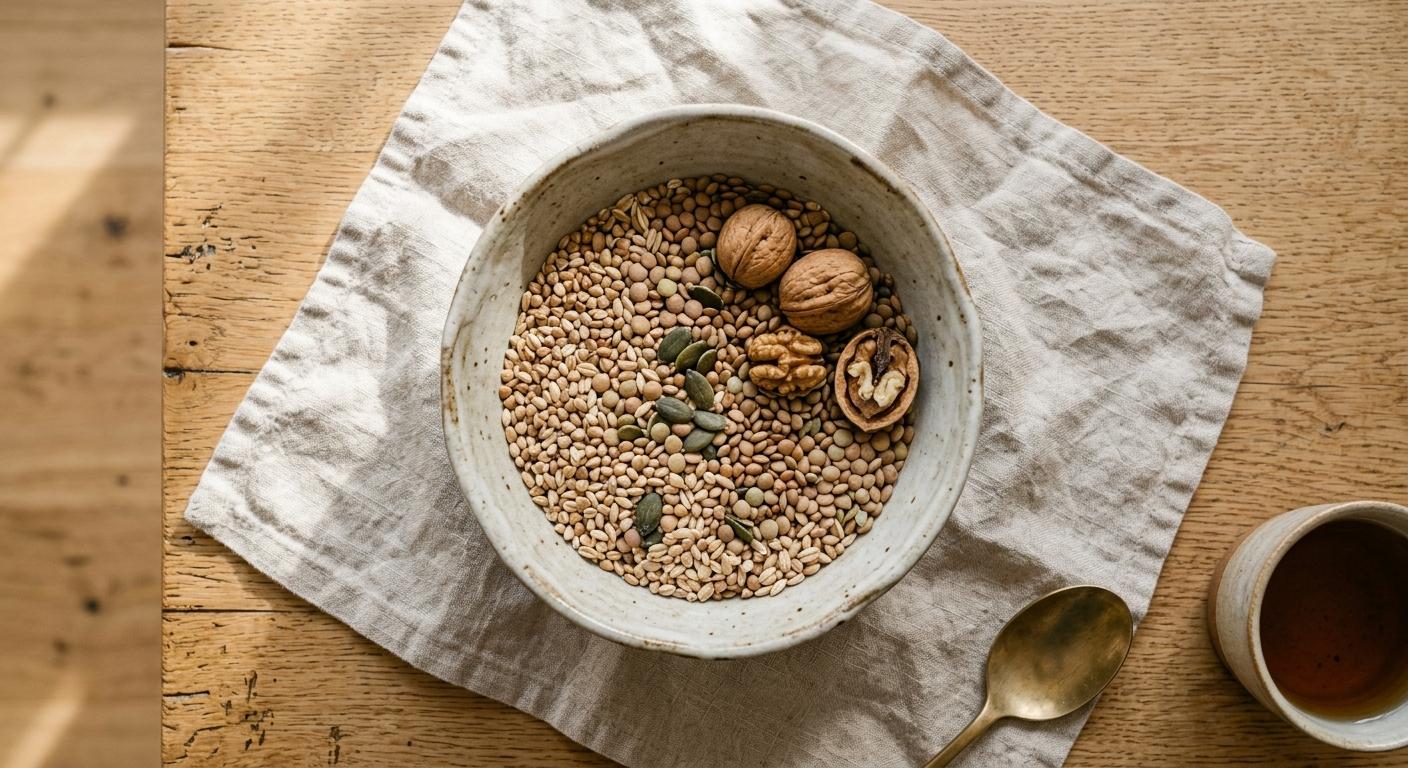
Selenium is part of enzymes that protect cells from damage by free radicals and support the immune system. Other selenium-dependent enzymes regulate thyroid hormones and help activate them ( DGE, 2021 ; SGE, 2026 ).
Why geography matters
The selenium content of plant foods depends largely on the soil they grow in. And Swiss soils are naturally low in selenium. Swiss federal researchers in agriculture and public health described Switzerland's natural conditions as unfavorable for an adequate selenium supply ( Sieber et al., 1999 ).
So where does selenium in the Swiss diet come from? In the 1990s, researchers traced it mainly to two routes: selenium-rich wheat imported from North America, and selenium added to livestock feed, which reaches us through meat, eggs and dairy. As wheat imports from North America fell, the feed route made up the difference. A 2008 study of 1,847 healthy blood donors from across Switzerland, who tend to be healthier than average, found that average selenium levels were adequate and had risen since a similar study in 1993, with very low values rare ( Burri et al., 2008 ). By a stricter benchmark that some experts use, though, a sizable share of people sits just below the ideal level ( Berger et al., 2021 ).
This means your selenium intake depends on what you eat and where it comes from. Someone who eats mostly local, plant-based food may get less selenium than a neighbor who eats fish, meat and eggs regularly ( DGE, 2021 ). That's why your diet is one of the first things worth considering when reading a selenium result.
More is not always better
Too much selenium can be harmful, which is why limits for supplements are strict. In Switzerland, a daily dose of a food supplement may contain at most 165 micrograms of selenium, and the German federal institute BfR recommends no more than 40 micrograms ( Swiss supplement ordinance ; BfR, 2024 ). Taking too much over a long time can cause hair loss and nail problems ( DGE, 2021 ). Brazil nuts are the richest food source, but their selenium content varies a lot: Swiss food data list about 58 micrograms in a 25-gram portion ( SGE, 2026 ). The German Nutrition Society advises eating no more than two a day, because Brazil nuts also accumulate radium, a naturally radioactive element ( DGE, 2021 ).
This is one of the clearest cases for measuring before supplementing.
Copper: the partner you rarely hear about
Copper rarely gets attention, but it works closely with iron. It contributes to normal iron transport, connective tissue, energy metabolism, the nervous system and the immune system ( Verbraucherzentrale, 2025 ). Because copper is involved in iron metabolism, too little of it can lead to anemia ( DGE, 2019 ).
True copper deficiency is very rare, but it does happen. Known causes include conditions such as celiac or Crohn's disease and, perhaps surprisingly, a high zinc intake, because zinc inhibits the uptake of copper ( Verbraucherzentrale, 2025 ).
Copper can also run high. Serum copper rises with infection and inflammation, during pregnancy and with higher estrogen levels. A high copper value on its own is therefore a clue to interpret, not a diagnosis.
The copper/zinc ratio: what the balance tells you
This is where a trace elements blood test can add context that a single value doesn't give. During inflammation, zinc in the blood tends to fall and copper tends to rise, so the copper/zinc ratio goes up.
Researchers have studied this ratio for decades. A long-running Finnish study followed 2,503 men aged 42 to 61 for a median of 26 years. Men with a higher copper/zinc ratio at the start were more likely to develop pneumonia. The link weakened but held when the researchers accounted for C-reactive protein, a standard marker of inflammation ( Kunutsor et al., 2022a ). In the same group of Finnish men, those with a higher ratio were also more likely to develop heart failure ( Kunutsor et al., 2022b ).
These are observational findings in men from one region of Finland, based on a single blood sample, so they show a link, not cause and effect. They suggest the ratio may reflect inflammation in a way single values don't, but it is a research marker, not a diagnosis. At Ahead Health, we report the ratio alongside zinc, selenium and copper as extra context for your physician's review.

Why a standard check-up often leaves trace elements out
A routine blood test in Switzerland usually focuses on a complete blood count, blood sugar, cholesterol, kidney and liver values. That makes sense: these markers cover the most common conditions efficiently. Trace elements are typically measured when there is a specific clinical question, such as suspected malabsorption, before or after bariatric surgery, or in hospital nutrition.
So if your symptoms are general, these values may never have been checked. Measuring trace elements as part of a preventive check-up can give you a baseline to compare against later.
It also helps your GP. A clear result, measured and interpreted by a physician, is a much better starting point for a conversation than "I read that I might need zinc."
How to read a trace elements blood test result
Serum values for trace elements are useful, but they have real limits:
- No single blood value tells the whole story. The signs of a shortfall are not specific, and blood levels are affected by more than diet. With a mild zinc deficiency, for example, the blood value can still be in the normal range ( gesund.bund.de, 2021 ). The German Nutrition Society adds that a zinc deficiency is ultimately confirmed when symptoms improve after taking zinc ( DGE, 2019 ). That's why our physicians read these values together and alongside your other markers, while taking into consideration any symptoms you may experience, your diet and lifestyle, the medications and supplements you take, and your medical history.
- Inflammation shifts the numbers. An infection can lower blood zinc even when there is no real deficiency ( gesund.bund.de, 2021 ), and it can also raise copper temporarily. That's why results are best interpreted alongside inflammation markers and how you felt at the time of the draw.
- Timing matters. Zinc levels change over the day, so a morning sample is more comparable over time.
- Supplements change the picture. If you take zinc, selenium or a multivitamin, mention it. It helps explain a high value and protects you from adding more of something you already have enough of.
- Repeat measurements tell a story. One result is a snapshot. A second test after a change in diet or supplementation can show whether your levels have moved.
The goal is to understand your levels well enough to make an informed choice: adjust your diet, start or stop a supplement, or explore a cause with your doctor.
Your trace elements blood test at Ahead Health
The Trace elements add-on is now available at all Ahead Health locations in Switzerland. You can add it to any Ahead blood check-up.
What's included:
- Zinc
- Selenium
- Copper
- Copper/zinc ratio
Your results appear in your Ahead health report next to the rest of your biomarkers , with plain-language explanations, and are reviewed by Swiss board-certified physicians. Seeing trace elements next to markers like iron, thyroid values and inflammation helps you and your doctor read them in context, which is how they make the most sense.
Conclusion
Zinc, selenium and copper are needed in tiny amounts, but they influence how you fight infections, how your thyroid works and how your body handles everyday oxidative and inflammatory stress. In Switzerland, soils are naturally low in selenium, and diets built mostly on plants can provide less zinc and selenium.
A trace elements blood test gives you a measured starting point instead of guesswork, as long as the results are read with the limits described above. If you have been wondering whether your minerals play a role in how you feel, knowing your levels gives you more options and a clearer conversation with your doctor.