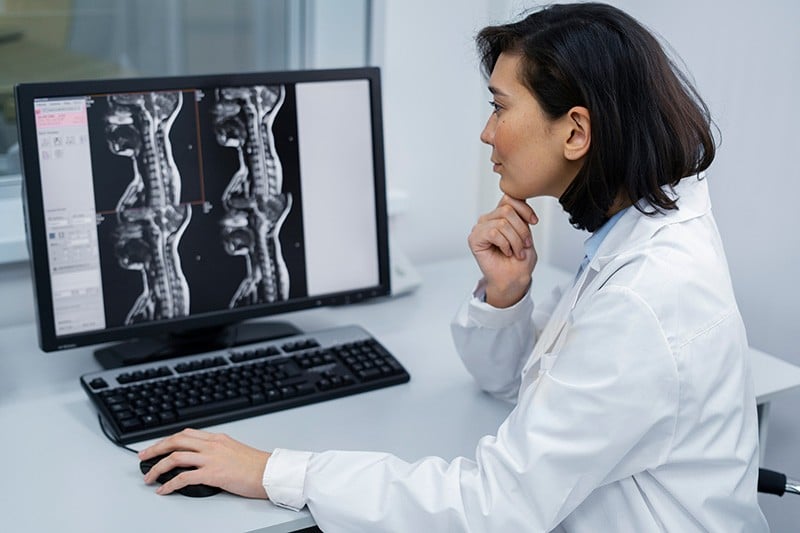
MRI vs CT scan: how to choose the right one
22 February 2026


Most people don't get to choose
When your doctor orders an MRI or CT scan, you usually get what they recommend. That works fine in reactive care, where something is already wrong and the clinician knows what they're looking for.
But in preventive health, the question is different. You're scanning for what might develop. The wrong tool can miss it entirely.
MRI and CT are fundamentally different technologies. They see different things. Treating them as interchangeable is how early disease gets missed.
This article explains what each scan actually sees, where it falls short, and how to choose the right one for your body and your risk profile.
MRI vs CT at a glance
| CT scan | MRI & full-body MRI | |
|---|---|---|
| Technology | X-ray beams | Magnetic fields and radio waves |
| Radiation | Yes (low-dose ionising) | None |
| Image detail | High-contrast views of bones, vessels, dense tissue | High-resolution views of soft tissues |
| Scan time | A few minutes | 5 for individual parts, and up to 90 minutes for full-body |
| Best for | Bones, blood vessels, lungs, calcifications | Brain, spine, joints, organs, muscles |
| Preventive role | Targeted risk assessment (e.g. arterial calcium) | Detecting structural and functional changes early |
How MRI works
MRI essentially reads water. It uses a powerful magnetic field to interact with water molecules throughout your body. Since soft tissues (muscles, organs, brain, skin) are mostly water, MRI sees them in high definition. Bone, less so.
The scanner detects how those molecules respond to the magnetic field and translates the signals into high-resolution cross-sectional images. The detail is fine enough to catch changes that other scans miss entirely.
No radiation involved. You can repeat MRI scans over time without cumulative exposure risk, which matters when monitoring is part of your health strategy. For a broader comparison of imaging modalities, Johns Hopkins offers a useful overview.
How CT works
CT rotates an X-ray beam around your body, capturing images from multiple angles and assembling them into detailed cross-sections. Different tissues absorb radiation at different rates. Bone and calcified structures absorb more than surrounding soft tissue, which creates the contrast that makes CT images so clear.
The entire process takes minutes. That speed, combined with strong contrast imaging, makes CT the go-to tool when you need a quick, targeted look at bones, blood vessels, or dense structures.
CT does use ionising radiation, though the doses are low and carefully targeted. A single abdominal CT delivers roughly 10 mSv, which the American College of Radiology considers low-risk for an individual scan. For preventive contexts where repeat imaging is part of the plan, cumulative exposure is worth factoring in.
It’s the reason that in Switzerland and at Ahead, before finalizing a CT-booking, a doctor needs to formally sign off based on risk scores.
What about contrast agents?
Most scans work fine without one. Contrast agents are substances introduced before a scan to make certain structures easier to see. Think of it as adding colour to a black-and-white image.
MRI contrast typically contains gadolinium, which highlights soft tissues, blood flow, and inflammation. CT contrast usually involves iodine-based agents that sharpen views of blood vessels, organs, and abnormal growths.
They can be ingested, injected, or introduced directly into a body cavity, depending on what's being imaged. Contrast agents are generally safe, though your radiologist will weigh allergies, prior reactions, and whether the added detail is clinically useful before recommending one.
In the preventative CT and MRI -scans we offer at Ahead, we don’t use contrast agents.
Does MRI use radiation?
No. MRI relies entirely on magnetic fields and radio waves.
CT does use low-dose ionising radiation. The doses are carefully calibrated and targeted, but in a preventive context where you scan periodically over years, cumulative exposure matters. It's one reason MRI is often the preferred baseline tool for ongoing health monitoring.
That said, MRI has its own constraints. People with certain metal implants, pacemakers, or other devices need to confirm their hardware is MRI-safe or MRI-conditional before scheduling a scan. Always check with your GP (Hausarzt) or radiologist first.
What each scan detects, and where it matters
Cancer risk
Most cancers start in soft tissue, which is exactly where MRI excels. Its resolution is fine enough to pick up unexpected masses, density shifts, and structural changes across organs. Sometimes years before symptoms would prompt a scan.
CT fills the gaps. When blood vessels are involved, when airways need detailed imaging, or when calcifications need clarification, CT gives the clearer picture. The two are often layered together to cover blind spots.
For preventive screening, MRI is the stronger first-line tool. A full-body MRI can surface tumours, cysts, and organ changes well before they'd show up in routine care. Some findings will require intervention; others just need monitoring. That's why clinical interpretation matters as much as the scan itself.
Heart and blood vessel health
A lot of people get a calcium score and assume their heart is covered. That captures one dimension of risk: calcified arterial plaque. It's a well-validated marker ( 2019 ACC/AHA guidelines give it a Class IIa recommendation for intermediate-risk adults), but it tells you little about non-calcified plaque, myocardial tissue health, or perfusion. The other dimension of cardiac risk requires a different scan entirely.
Cardiac MRI looks at the myocardium directly. It detects changes in tissue composition, early oedema, and inflammation. These are signs of heart disease that can develop silently even when your arteries look fine.
CT is the stronger tool for blood vessels. A coronary calcium score quantifies calcium buildup in your heart's arteries, giving you a direct, numbers-based read on accumulated cardiovascular risk. CT angiography maps narrowing and plaque with speed and precision.
The full cardiovascular picture requires both: MRI for the muscle, CT for the arteries. Memorial Sloan Kettering covers the clinical reasoning behind combining the two.
Brain and neurological health
Many neurological conditions develop quietly for years. Vascular and structural changes in the brain can appear long before symptoms, and when symptoms do emerge, they often mimic other conditions.
Brain MRI evaluates brain structure and tissue integrity. It can detect early markers like white matter hyperintensities, microvascular injury, inflammation, and volume loss patterns. A meta-analysis of 36 prospective studies found that white matter hyperintensities at baseline conferred a 14% elevated risk of all-cause dementia and a 73% elevated risk of vascular dementia. These are changes worth catching early.
CT provides fast clarity on structural abnormalities: haemorrhage, calcifications, acute vascular events. For the brain, MRI is the preventive tool; CT is the urgent one.
Muscles, joints, and bones
Musculoskeletal decline is gradual, which is precisely why it's so often caught late. By the time you feel persistent pain or stiffness, the underlying changes have usually been developing for years.
Cartilage thinning, bone marrow oedema, disc degeneration, ligament wear: these show up on MRI before they produce symptoms. So does the low-grade inflammation that, left alone, progresses to chronic pain and restricted mobility.
Bone spurs, spinal compression, and subtle fractures are CT's territory. Fast, clear, high-contrast. Together, the two give you the full wear picture: soft tissue on MRI, structure on CT.
Reproductive and pelvic health
Reproductive health is one of the most overlooked areas of preventive screening, for both men and women.
For women: Gynaecologic conditions frequently progress with vague symptoms that get dismissed as normal. Pelvic MRI can reveal fibroids, ovarian cysts, structural changes, and deep-infiltrating endometriosis . While transvaginal ultrasound performs well for posterior compartment disease, meta-analyses show MRI offers broader anatomical coverage and higher sensitivity for anterior and multi-compartmental involvement. For many women, it's the first scan that actually explains chronic pelvic pain or fertility challenges.
For men: Multiparametric MRI has transformed prostate evaluation. The PRECISION trial (NEJM, 2018) showed that MRI-targeted biopsy detected 38% more clinically significant prostate cancers than standard ultrasound-guided biopsy, while also reducing detection of indolent disease. MRI is also valuable for broader pelvic assessment, including testicular conditions and structural changes. CT adds value when blood vessel involvement or calcifications need clarification.
Incidental findings
Both MRI and CT can reveal changes that weren't the original reason for the scan but turn out to be clinically relevant. A full-body MRI might surface previously unknown tumours, cysts, vascular changes, or organ enlargement. CT might reveal calcifications or structural changes in your heart, brain, or lungs.
These findings are why preventive imaging can shift the conversation from "what's wrong?" to "what do we watch?"
Imaging findings should always be interpreted by a qualified clinician alongside your medical history. This article is for educational purposes and does not replace professional medical advice.
How Ahead Health uses MRI and CT
At Ahead Health, preventive imaging is the foundation of our approach. The goal is to scan intelligently, matching the right tool to your specific risk profile.
Our AI-assisted analysis helps prioritise findings based on size, location, progression risk, and correlation with blood biomarkers. The system recognises patterns that can flag serious risks before they'd otherwise be noticed. Your GP then reviews the full picture (imaging, bloodwork, history) to assess what needs immediate action, what calls for lifestyle changes, and what should be monitored over time.
All results are reviewed and validated by board-certified Swiss clinicians.
Want to find out whether your risk profile calls for MRI, CT, or both? Book a discovery call and we'll help you figure out the right starting point.

CEO
First employee, CTO, and CMO at Coolblue, contributing to a 1B+ exit. Former product executive at Google for Flights and Shopping, and CCO at Suitsupply, overseeing DTC growth with 100+ stores. Recently incubated the consumer healthtech company, Everyman.