EARLY DETECTION
Dementia and Alzheimer's: statistics, early detection, and prevention

Written by
Nick Lenten
Reviewed by

Dementia is not one disease. It is a category, an umbrella over a family of progressive neurological conditions that strip away memory, reasoning, and eventually the ability to get through the day without help. Over 57 million people are living with it worldwide. By 2050, that number is projected to reach 139 million.
And yet 75% of cases globally go undiagnosed. Worse: 62% of healthcare professionals still believe dementia is a normal part of aging. It is not. It is a medical condition, one that can be detected, managed, and in many cases significantly delayed – especially when identified early.
This guide covers the latest dementia and Alzheimer's statistics, the early warning signs worth knowing, and what preventive medicine can do before symptoms arrive.
What is the difference between dementia and Alzheimer's?
People use these terms interchangeably. The distinction matters clinically.
Dementia is the broad term for cognitive decline severe enough to disrupt daily life. It covers many diseases and causes.
Alzheimer's disease is the most common cause of dementia, responsible for 60–80% of all cases. It is a specific neurodegenerative disease in which amyloid plaques and tau tangles accumulate in the brain, progressively killing neurons.
Types of dementia and their prevalence
Dementia type | Share of cases | Key characteristics |
|---|---|---|
Alzheimer's disease | 60–80% | Gradual memory loss, disorientation, language difficulties |
Vascular dementia | 15–20% | Caused by reduced blood flow; often follows stroke |
Lewy body dementia | 10–15% | Visual hallucinations, movement disorders, fluctuating cognition |
Frontotemporal dementia (FTD) | 2–3% | Personality and behaviour changes; 60% of cases occur between ages 45–60 |
Parkinson's disease dementia | 2–3% | Develops in 24–50% of Parkinson's patients, typically 10 years after motor symptoms |
Mixed dementia | ~10% | Two or more types simultaneously; autopsy studies show 82% of elderly Alzheimer's patients also had another dementia type |
Knowing which type is involved changes treatment, prognosis, and how families prepare. It is also one of the strongest arguments for early diagnostic imaging.
How to recognise dementia: early signs and symptoms
The first symptoms are quiet. Easy to attribute to stress, tiredness, or normal aging. Knowing what to look for can mean years of proactive management rather than a late-stage diagnosis with few options.
Common early warning signs
Memory loss that disrupts daily life. Forgetting recently learned information, important dates, or asking the same question repeatedly.
Difficulty planning or solving problems. A recipe that used to be routine. Bills that used to get paid on time.
Confusion with time or place. Losing track of dates, seasons, or how they got somewhere.
Trouble understanding visual and spatial relationships. Difficulty reading, judging distance, or distinguishing colours.
New problems with words. Struggling to follow a conversation, stopping mid-sentence, calling familiar objects by the wrong name.
Misplacing things without being able to retrace steps. Items found in unusual places, with no memory of how they got there.
Decreased or poor judgement. Especially around money or personal hygiene.
Withdrawal from social activities. Dropping hobbies, avoiding people, disengaging from work.
Changes in mood and personality. Anxiety, suspicion, depression, fearfulness.
Difficulty completing familiar tasks. Trouble driving a known route, managing a budget, remembering the rules of a favourite game.
Signs of dementia in men
The core symptoms are the same across sexes, but men tend to present differently, which delays diagnosis. Men are more likely to become irritable and aggressive rather than sad or withdrawn. They lose initiative. They stop engaging with hobbies or people without explanation. Risk-taking and impaired judgement are often more pronounced. And they are statistically less likely to raise cognitive concerns with a doctor.
80% of the population reports worrying about developing dementia. Yet 25% believe nothing can be done to prevent it. That gap between fear and action is where early awareness matters most.
Dementia statistics: the global and Swiss picture
Worldwide
57 million+ people currently live with dementia
139 million cases projected by 2050
A new diagnosis every 3 seconds
60% of current cases are in low- and middle-income countries, rising to 71% by 2050
Switzerland
Switzerland faces a growing burden. By 2050, the country is projected to reach roughly 33 dementia cases per 1,000 people, among the higher rates in Europe.
Projected dementia rates per 1,000, Europe (2050):
Country | Cases per 1,000 |
|---|---|
Italy | 43 |
Spain | 41 |
Germany | 36 |
France | 34 |
Switzerland | 33 |
Netherlands | 33 |
Belgium | 31 |
Great Britain | 28 |
Despite these projections, dementia does not feature in Switzerland's standard preventive check-up (Grundversicherung). Cognitive risk assessment falls outside what a routine Hausarzt appointment typically covers. This is the structural gap that proactive screening is designed to fill.
Mortality
Dementia is the 7th leading cause of death globally. Alzheimer's fatalities rose 145% between 2000 and 2019 – a period when deaths from stroke, heart disease, and HIV all fell.
In the UK, over 74,000 deaths in 2022 were attributed to dementia: 11.3% of all deaths. Women are disproportionately affected, making up the majority of patients and providing 70% of all dementia care.
Genetic and hereditary risk factors
Genetics influence Alzheimer's risk but are far from deterministic. The ApoE4 variant is the strongest known genetic risk factor for late-onset Alzheimer's – carrying one copy roughly doubles or triples the risk, two copies raises it considerably more – but many carriers never develop the disease, and many Alzheimer's patients carry no variant at all. A full overview of how genetics interact with Alzheimer's risk is available from the National Institute on Aging.
A small subset – roughly 5% of all Alzheimer's cases – is caused by rare mutations in the APP, PSEN1, or PSEN2 genes, producing familial Alzheimer's disease (FAD). These cases tend to appear before age 65, sometimes as early as 30. If a parent carries one of these mutations, each child faces a 50% chance of inheriting it. For people with a strong family history of early-onset Alzheimer's, a conversation with a neurologist or geneticist is the right starting point – this falls outside what standard preventive screening addresses.
Vascular dementia: the most preventable form
Vascular dementia is the second most common type, accounting for 15–20% of cases. It develops when conditions block or reduce blood flow to the brain – through stroke, series of mini-strokes (transient ischaemic attacks), or the gradual narrowing of small cerebral vessels – starving cells of oxygen and causing cumulative damage.
Unlike Alzheimer's, vascular dementia follows a stepwise pattern: relatively stable periods punctuated by sudden steps of decline, each corresponding to a vascular event. Planning, organising, concentration, and processing speed are typically the first functions affected.
Why it matters for prevention
Vascular dementia is driven almost entirely by the same risk factors as cardiovascular disease: hypertension, high cholesterol, type 2 diabetes, smoking, atrial fibrillation, and obesity. These are all detectable years before they damage the brain. They are all modifiable. This makes vascular dementia the type where proactive screening has the clearest, most direct payoff – treating hypertension or managing blood sugar in midlife is not just protecting the heart, it is protecting the brain.
The Lancet Commission's 2024 analysis attributes a substantial share of dementia risk to vascular and metabolic factors that operate over decades. The window for meaningful intervention is not at diagnosis. It is 10 or 20 years earlier.
What brain MRI shows
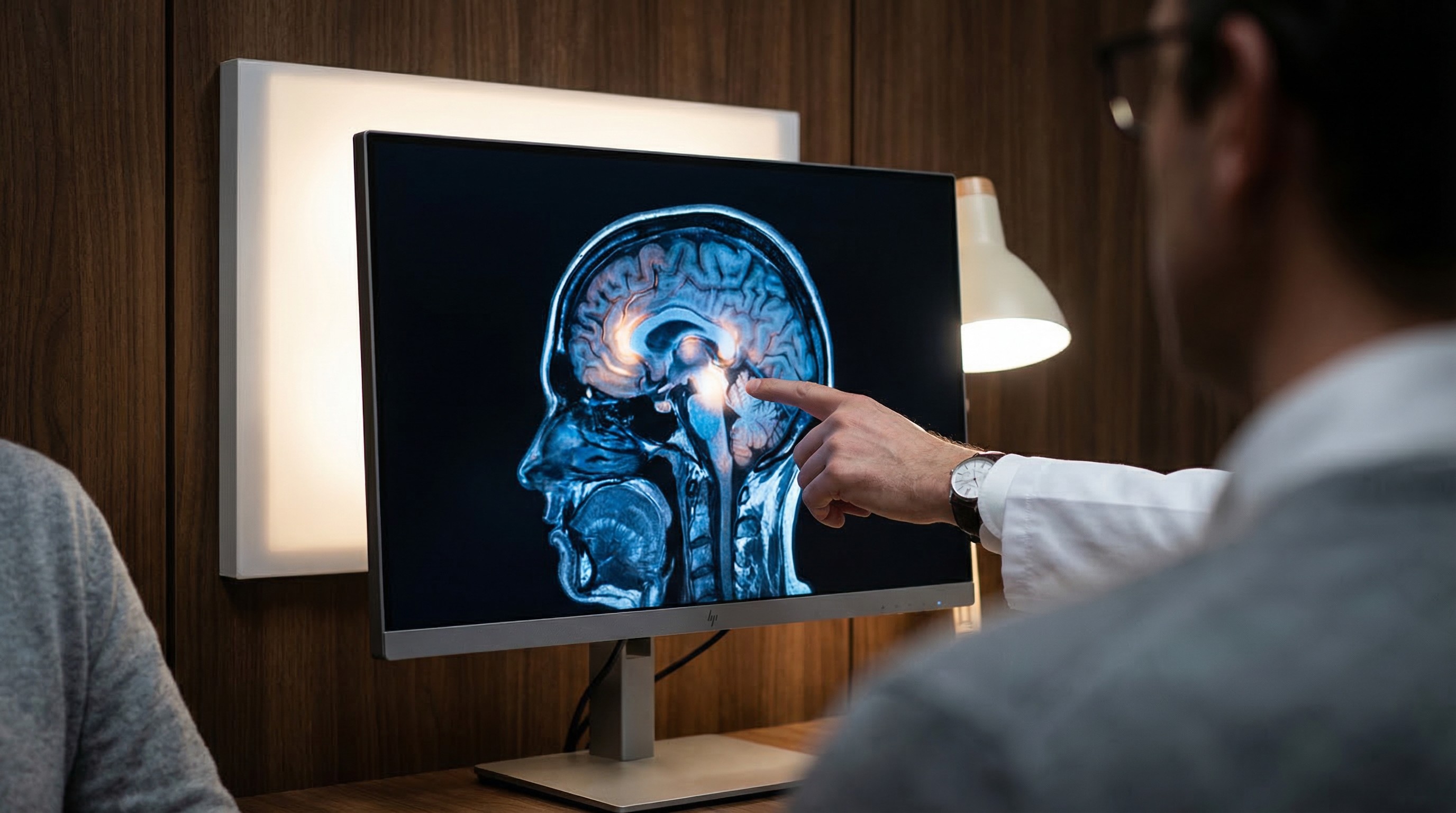
A high-resolution brain MRI can detect the structural signs of vascular damage long before cognitive symptoms appear:
White matter lesions (leukoaraiosis): areas of vascular damage in the brain's white matter, strongly associated with progression to vascular dementia
Silent infarcts: small strokes that produced no outward symptoms but left detectable damage – present in up to 20% of adults over 60 in imaging studies
Microbleeds: tiny cerebrovascular haemorrhages that indicate fragile vessel walls and elevated future stroke risk
Lacunar infarcts: small deep-brain strokes, often from small vessel disease driven by hypertension
Finding these changes in midlife – before cumulative damage reaches a clinical threshold – is exactly when intervention is most effective. A single scan can identify people at high vascular dementia risk a decade or more before symptoms would otherwise appear.
Life expectancy after diagnosis
Average survival after vascular dementia diagnosis is roughly 5 years, ranging from 1 to over 10. Prognosis is often shorter than for Alzheimer's because of the underlying cardiovascular disease burden. But the trajectory can be meaningfully changed: aggressive cardiovascular management after diagnosis – blood pressure control, anticoagulation for atrial fibrillation, cholesterol management, smoking cessation – slows progression in ways that equivalent interventions for Alzheimer's currently cannot match.
Prevention: 45% of dementia cases could be prevented or delayed
Up to 45% of dementia cases are linked to modifiable risk factors (Lancet Commission 2024, updated from 40% in 2020 after new evidence on vision loss and high LDL cholesterol). Lifestyle changes and proactive monitoring can cut your risk substantially, even if your genetics are working against you.
Modifiable risk factors
Risk factor | Prevention potential | Action |
|---|---|---|
Hearing loss (ages 45–65) | 8% | Regular hearing tests; hearing aids when indicated |
Low cognitive stimulation | 7% | Lifelong learning, language learning, cognitive engagement |
Smoking | 5% | Cessation at any age reduces risk |
Traumatic brain injury | 3% | Protective equipment; fall prevention |
Physical inactivity | Significant | 150+ minutes moderate exercise per week |
Hypertension (midlife) | Significant | Blood pressure monitoring and management |
Excessive alcohol | Significant | Moderate or no alcohol intake |
Obesity (midlife) | Significant | Healthy weight maintenance |
Depression | Significant | Early treatment and ongoing support |
Social isolation | Significant | Active social and community engagement |
Air pollution | Significant | Reducing exposure where possible |
Diabetes | Significant | Blood sugar management, metabolic screening |
The shingles vaccine and dementia risk
A 2023 paper in Nature Medicine found that people who received a recombinant shingles vaccine had a lower incidence of dementia in the following years. The study used a natural experiment in Wales – where the older Zostavax vaccine was available to people born before a certain date but not after – to approximate a causal design. The findings are intriguing, but the evidence is still observational. The mechanism is not established, no randomised trial has confirmed a causal link, and no European or Swiss health authority currently recommends the shingles vaccine specifically for dementia prevention. The research is worth following.
The diagnostic gap: why 75% of cases go undetected
Tens of millions of people have dementia and don't know it. The reasons are structural and cultural.
According to the World Alzheimer Report 2024, 62% of healthcare professionals view dementia symptoms as a natural part of aging. 35% of families globally conceal a diagnosis from others. 55% of primary care physicians say they cannot get patients to specialists quickly enough. When symptoms appear before 65, they are blamed on stress, depression, or burnout.
Unlike cardiovascular disease or cancer, dementia screening is not part of standard check-ups in most healthcare systems, including Switzerland's. The Grundversicherung does not cover cognitive risk assessments. Most people encounter the diagnosis only after significant decline has already occurred.
The cost of this gap is concrete. Early detection opens access to disease-modifying treatments while they still work. It creates a window for lifestyle interventions that matter most early. It allows financial and legal planning before cognitive capacity erodes. It makes patients eligible for clinical trials of emerging therapies. Late diagnosis closes all of those options.
The economic and human cost
Financial impact
The global cost of dementia is $1.3 trillion per year in direct and indirect costs, projected to reach $2.8 trillion by 2030.
In the United States, Medicare and Medicaid spend $231 billion on dementia-related care. Dementia patients require twice the annual hospital visits of non-dementia elderly, amounting to 1,545 emergency visits per 1,000 Medicare beneficiaries each year.
The caregiver burden
70% of caregivers report significant stress coordinating care. Over 50% say their own health has declined as a result. 6 in 10 are simultaneously holding down jobs, working an average of 35 hours per week. Staff turnover in professional dementia care reaches 77% for home care workers and 99% for nursing home assistants.
These numbers make the case for prevention in purely economic terms. Early detection is a financial priority alongside a medical one.

How brain MRI and advanced blood tests enable early detection
Waiting for symptoms is a losing strategy. By the time memory loss is obvious, significant brain damage has already occurred. Two tools can identify trouble years earlier.
Brain MRI
A high-resolution brain MRI can detect:
Hippocampal atrophy: shrinkage of the brain's memory centre, one of the earliest structural markers of Alzheimer's
White matter lesions: indicators of vascular damage that may signal vascular dementia risk
Cortical thinning: patterns of brain tissue loss tied to specific dementia subtypes
Microbleeds and silent infarcts: evidence of cerebrovascular disease that raises dementia risk
Tumours and structural abnormalities that can cause cognitive symptoms unrelated to neurodegeneration
These changes can appear years to decades before symptoms. A baseline brain MRI in midlife gives you a reference point; future scans become far more informative with that comparison in hand.
Advanced blood biomarkers
Blood tests can now assess:
Inflammatory markers: chronic systemic inflammation is increasingly linked to neurodegeneration
Metabolic and cardiovascular risk factors: diabetes, high cholesterol, and hypertension are all modifiable contributors – and as the vascular dementia evidence makes clear, managing these is one of the most concrete things you can do for brain health
Emerging plasma biomarkers: including p-tau217 and neurofilament light chain (NfL), being validated for early Alzheimer's detection
Think of brain imaging as assessing your body's hardware – the structural state of the brain itself – and blood biomarkers as the software layer, revealing the biochemical processes running underneath. As Dr. Anna Erat, Ahead's medical lead, puts it: ""The brain gives far fewer early warning signals than the heart does. By the time someone is noticing problems, we've often already passed the window where intervention has the most impact. Structural brain imaging in midlife is about understanding your trajectory – early enough to change it."
What you can do today
Dementia is not inevitable. You cannot eliminate all risk, but you can reduce it substantially. Starting earlier means more benefit from every intervention.
Establish a baseline. A full-body MRI including brain imaging creates a structural reference point you can track over time.
Get your blood work done. Advanced panels covering inflammatory markers, metabolic indicators, and cardiovascular risk factors give a detailed biochemical picture of brain health.
Address cardiovascular risk factors. Hypertension, diabetes, high cholesterol – all modifiable, all directly linked to dementia.
Stay physically active. 150+ minutes of moderate exercise per week is one of the strongest evidence-based interventions available.
Protect your hearing. Hearing loss in midlife is the single largest modifiable risk factor for dementia. Get tested; use hearing aids if recommended.
Engage your brain. Learning, social interaction, and cognitive challenge build cognitive reserve.
Don't wait for symptoms. By the time memory loss is apparent, the damage is already extensive.
How Ahead Health supports cognitive risk assessment
Ahead Health offers full-body health assessments designed for people who want a clear picture of their risk before symptoms arrive – the reactive-to-proactive shift that standard Swiss check-ups don't provide.
The Ahead Pro package (CHF 3,549) includes full-body MRI with high-resolution brain analysis, advanced blood panels, hormones and vitamins screening, and AI-assisted review by Swiss board-certified physicians. For those starting with a broader baseline assessment, Ahead Advanced (CHF 2,490) covers the full-body MRI alongside an 80+ biomarker blood panel that includes inflammatory markers, metabolic and cardiovascular indicators, and emerging neurodegeneration-relevant biomarkers. The cardiovascular component of the blood panel is particularly relevant here: hypertension, elevated cholesterol, insulin resistance, and inflammatory markers are not just heart disease risk factors – they are among the most actionable determinants of vascular dementia risk.
These assessments complement your Hausarzt rather than replacing them. The results go to you and, if you choose, to your GP, giving your doctor the kind of detailed baseline data that a standard Grundversicherung check-up doesn't produce.
Finding potential issues when they are small and manageable is the best time to find them. That is the point.
Supplementary health insurers may cover part of the cost. KPT, CSS, AXA, Visana and Atupri are all reimbursing part of the cost for Ahead Health services depending on their T&Cs, some with up to CHF 1,500. You can check how much you can get reimbursed and request a pro-forma invoice on our insurance page.
Conclusion
Dementia is a medical condition, not an inevitability. Up to 45% of cases are linked to factors you can act on. The window for meaningful intervention is wide – but only if you know where you stand before symptoms begin. Brain imaging and advanced blood biomarkers exist precisely to give you that information. The question is whether you use them early enough for it to matter.
FAQ
Can dementia be prevented?
How do you recognise the early signs of dementia?
At what age should you start screening for dementia risk?